Educational Notice
This article is for educational purposes only and is not medical advice. Medication selection, protein targets, exercise changes, and body-composition concerns should be discussed with a licensed clinician when appropriate.
Plain-English Summary
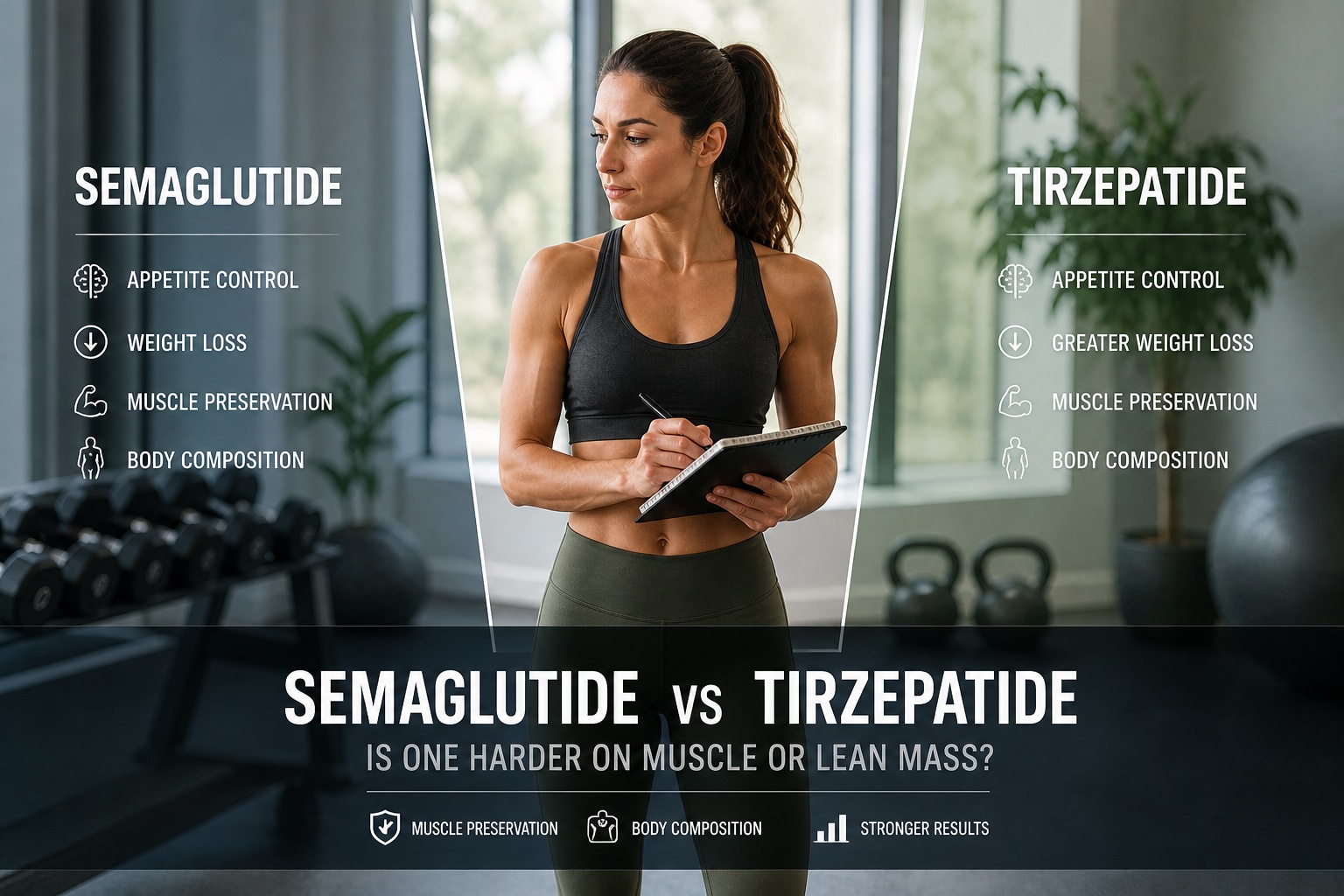
Current evidence does not support a simple claim that semaglutide or tirzepatide is universally harder on muscle.
Both drugs can reduce some lean mass while body weight is falling. Tirzepatide may produce larger overall weight and fat-mass reduction in some studies, but the existing evidence is still not strong enough to say that one medication is always better or worse for lean-mass preservation in real-world use.
For most people, the bigger practical factors are:
- how quickly weight is coming off
- whether protein intake is adequate
- whether resistance training is happening consistently
- whether strength and body composition are being tracked with more than the scale
Who This Matters For
This article matters most for:
- people deciding between semaglutide and tirzepatide
- people already using one of these drugs and worrying about muscle loss
- adults over 40 who care about strength, function, and frailty risk
- readers who want a better body-composition result, not just a lower scale number
Key Takeaways
- both semaglutide and tirzepatide can be associated with some lean-mass loss during weight loss
- current evidence does not justify a blanket claim that one is always harder on muscle
- tirzepatide may outperform semaglutide on fat-mass reduction in some comparisons, but its effect on fat-free mass remains uncertain
- the higher-quality question is not just “which drug causes more loss,” but “how do I protect lean mass while losing fat”
- resistance training, protein, and rate of loss still matter more than medication brand name alone
What the Evidence Says
The strongest practical conclusion is cautious, not absolute.
A 2024 systematic review and network meta-analysis found that GLP-1 receptor agonists and GLP-1/GIP co-agonists reduced total body weight, fat mass, and lean mass overall. In that analysis, tirzepatide 15 mg weekly and semaglutide 2.4 mg weekly were among the most effective for total weight and fat-mass reduction, but also among the least effective in preserving lean mass. See pubmed:39719170.
A 2024 systematic review focused on tirzepatide found that tirzepatide appeared to reduce total fat mass, visceral adipose tissue, and waist circumference substantially. Compared with some other anti-obesity medications taken over similar durations, including semaglutide, tirzepatide showed stronger decreases in body-fat compartments. But the review also concluded that the effect of tirzepatide on fat-free mass remains uncertain because findings are still inconclusive. See pubmed:39329873.
A 2025 review on skeletal muscle health noted that clinical trials of incretin-based therapies suggest proportional loss of fat and lean mass during weight loss, while preclinical and translational work hints that the picture may be more complex than a purely muscle-wasting effect. See pubmed:41011082.
A 2026 review on fat, muscle, and anti-obesity medications made the concern even more explicit: a consistent component of pharmacologic weight loss can include lean body mass, and resistance training is currently the main suggested strategy for preserving skeletal muscle and function during treatment. See pubmed:41914150.
What the Evidence Does Not Say
The evidence does not currently prove:
- that semaglutide is always harder on muscle than tirzepatide
- that tirzepatide is always harder on muscle than semaglutide
- that everyone on either drug will experience clinically meaningful weakness or muscle loss
- that medication choice alone determines the quality of the body-composition outcome
This is important because readers often want a clean winner and loser. The evidence is not that clean yet.
Human Evidence
Most of the useful evidence here comes from systematic reviews, meta-analyses, and body-composition sub-analyses rather than from large long-term head-to-head trials designed specifically to answer the “which is harder on muscle” question.
That means we can say some things with confidence:
- both drugs can be associated with lean-mass reduction during weight loss
- tirzepatide appears highly effective for reducing total weight and body-fat compartments
- body-composition outcomes deserve more attention than scale weight alone
But we should still be careful about pretending there is a final answer on head-to-head muscle preservation.
Mechanistic and Translational Context
The muscle story is probably not purely about the drug itself.
When people lose weight quickly, some lean-mass loss often happens regardless of the method. Incretin-based therapies may also change appetite, total intake, and meal structure in ways that make adequate protein and resistance-training consistency harder to maintain.
That is one reason the literature keeps returning to the same practical themes:
- higher-quality weight loss
- preservation of muscle and function
- resistance exercise
- adequate protein intake
- better body-composition monitoring
Anecdotal Reports, Clearly Labeled
Public discussions often frame the question in very direct terms:
- “Is Zepbound harsher on muscle than Wegovy?”
- “I feel smaller and softer on one medication.”
- “My strength dropped while the scale improved.”
Those reports are useful for understanding what readers are worried about, but they are not clinical proof that one medication is categorically worse than the other.
Practical Implications
1. Do not choose a medication based on muscle-loss fear alone
Medication choice should usually consider:
- clinical goals
- tolerability
- access and insurance realities
- total weight-loss response
- your ability to support muscle preservation while on treatment
2. Treat body-composition quality as part of the plan
If you are comparing semaglutide and tirzepatide, do not just ask which one lowers scale weight more. Ask whether your plan supports:
- adequate protein
- resistance training
- strength maintenance
- reasonable pace of loss
Need A Practical Starting Point?
Use the GLPLeanMass Protein Calculator to estimate a body-size-based protein range and pressure-test whether your current eating pattern is actually supporting lean-mass preservation.
3. Watch what happens in the gym and in daily function
Useful signals include:
- major strength drop-offs
- lower training tolerance
- poorer recovery
- rapid weight loss paired with obvious muscle flatness or weakness
4. Use more than the scale
Better tracking can include:
- waist measurement
- progress photos
- body-composition scans when available
- training performance
Need To Compare Online GLP-1 Providers?
If you are still figuring out where to start, compare the current GLP Lean Mass partner options through a lean-mass lens before you choose a telehealth path.
Affiliate disclosure: The comparison page includes partner links. GLP Lean Mass may earn a commission if you sign up through them, but the page is still written to help you think more clearly about fit, cautions, and next steps.
Safety and Regulatory Notes
This article is educational only. It is not individualized medical advice and does not recommend dosing, self-experimentation, or unsupervised medication changes.
Readers should be especially cautious of:
- social-media certainty that outruns the evidence
- protocol sellers who promise “all fat, no muscle loss”
- conclusions drawn from scale change alone
Questions To Ask Your Clinician
- Is my current rate of weight loss too aggressive for my goals?
- What should I track besides scale weight?
- Does my age, training status, or medical history put me at higher risk of excessive lean-mass loss?
- Should I be doing more resistance training or paying more attention to protein while on this medication?
Make Monitoring Part of the Plan
If you are using a GLP-1, provider choice, protein, training, and symptom follow-up all connect. Lab work cannot measure muscle directly, but it can help your clinician monitor blood sugar, lipids, kidney and liver markers, and symptom-driven concerns while you protect lean mass.
Compare The Next-Wave Medication Conversation Too
If you are comparing medications based on weight-loss quality and not just scale speed, use the new three-way guide before assuming retatrutide changes the muscle-preservation equation by itself.
Bottom Line
If you are comparing semaglutide and tirzepatide, the current evidence does not support a simplistic answer that one is universally harder on muscle.
Both can involve some lean-mass loss while weight is coming down. Tirzepatide may produce stronger fat-mass reduction in some studies, but that does not automatically settle the lean-mass question for every patient.
The better real-world question is:
- how fast are you losing weight
- how well are you protecting protein intake
- whether you are giving your body a resistance-training signal
- whether you are tracking strength and body composition, not just pounds lost
That is where higher-quality outcomes are most likely to come from.
Keep Going
References
- pubmed:39719170 Effect of glucagon-like peptide-1 receptor agonists and co-agonists on body composition: Systematic review and network meta-analysis.
- pubmed:39329873 The Effect of Tirzepatide on Body Composition in People with Overweight and Obesity: A Systematic Review of Randomized, Controlled Studies.
- pubmed:41011082 Impact of Incretin-Based Therapy on Skeletal Muscle Health.
- pubmed:41914150 Fat, muscle, and anti-obesity medications in cardiovascular disease prevention.
- pubmed:38687506 Incretin-Based Weight Loss Pharmacotherapy: Can Resistance Exercise Optimize Changes in Body Composition?
- pubmed:40926900 Efficacy of lifestyle modification combined with GLP-1 receptor agonists on body weight and cardiometabolic biomarkers in individuals with overweight or obesity: a systematic review and meta-analysis.